- Voice or text
- A breakdown after the call
- Your product, your words
- Conversation
- Breakdown
- Again
We don’t teach sales.
We build sales ability.
Andrey Sizov’s method, put into a trainer and going through the author’s own review. This is not AI that sells instead of you — it is AI that makes you better at selling.
Stronger After Every NO. Sales without pressure, performance without burnout.
You have 40 tokens — about 4 written sessions or ~6 minutes of live voice.
The Sales Ladder — Foundations and eight rungs
Foundations and the eight rungs of Andrei Sizov’s Ladder, from first contact to the client after the deal. The free trial is “The Flea” on rung 5. Once you buy tokens the trainer takes you through five stages: the first exercise is “Using the “I’ll think about it” Objection”, the exercises of the first two stages and the three Foundations exercises are open from the start, and after that each rung is opened by passing the one before it.
AI sales role-play · How Sales Commander works
Where does your sale fall apart?
A deal doesn’t die in one place. Here is the path of a conversation and every turn where the client steps off it: first what the seller saw, then what actually happened.
Rung 0. Foundations
Nothing has been said yet, so nothing can break. This is where the rest is set.
Rung 1. Guest / Host
- The conversation never started.because the first contact came off as pushy
Rung 2. Earn the Ear
- He never heard a word of it.because he was braced for a pitch from the first second
Rung 3. The Scout
- You showed the product right away.because you never asked what he actually needed
- You pitched the wrong thing.because the need was never uncovered
Rung 4. Drawing into the Benefit
- It didn’t land.because you were reading out features
- You named the benefit and nothing moved.because you never asked what it had to do with him
Rung 5. The Financial Adviser
- He agreed it was about him and still walked.because he never counted what leaving it as is costs him
- He left to think it over and never came back.because “I’ll think about it” was taken as an answer, not as the start of the conversation
- He almost said yes and it slipped.because you had nothing to close with
Rung 6. The Cashier
- He said “I’m buying” and never paid.because the payment was never actually agreed
Rung 7. The Fairy
- He paid and never came back.because nobody spoke to him after the payment
- He left without buying and took the awkwardness with him.because the refusal was left hanging in the air
Rung 8. The Development Director
- He left happy and vanished.because the next conversation was never set
- He was happy and never sent anyone.because the referral was simply never asked for
- He complained and left.because you argued back
Every one of these moments is trained on its own: 27 positions across 9 rungs of the Ladder.
Get reps on the exact moments that cost you deals.
- 1Sell to the AI client.
You get a live conversation with a client who talks like a real one — guarded at “hello,” vague about what he needs, quick to hide behind “I’ll think about it.” You sell — in your own words, for your own product. No script to memorize.
- 2Get the breakdown.
The second the call ends, you get a straight, specific debrief: where you moved the sale forward, where you pushed too hard, and the one move that would’ve flipped it. Not generic “good job” — the actual play, step by step.
- 3Walk into the real call ready.
You walk into your next live appointment having already run that exact moment ten times. So when a real client goes quiet, stalls or says “let me think about it,” you don’t freeze. You know the move.
- Calmly accept: he was right to say it — thank him
- Remind him the choice is his and check he has all the information
- Ask what he noticed as an advantage / what he liked
- Thank him — “one of the things I wanted to show you” — and ask why exactly that caught his attention
- “Good that you noticed it” — tell a case tied to what he noticed
The product in action
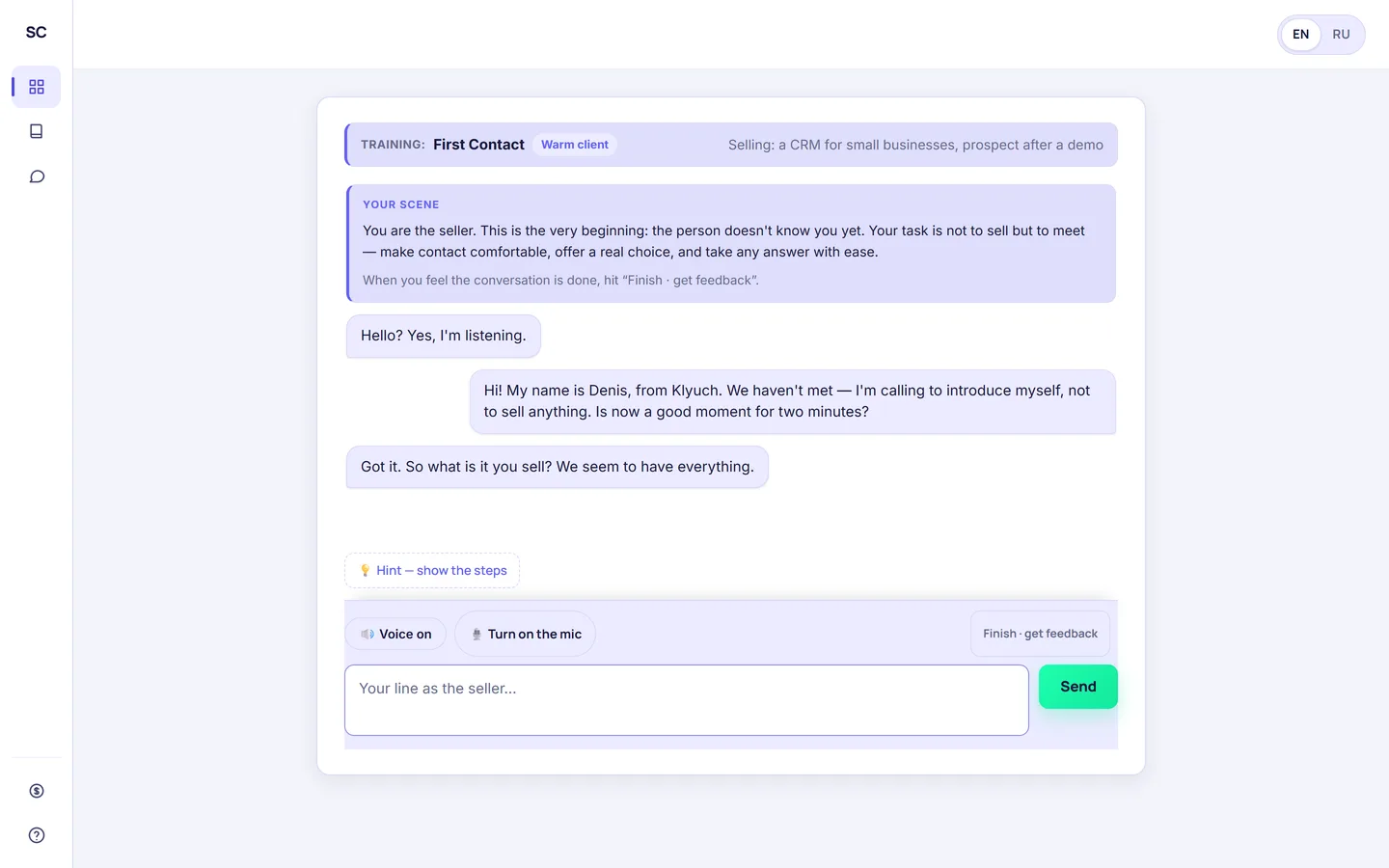
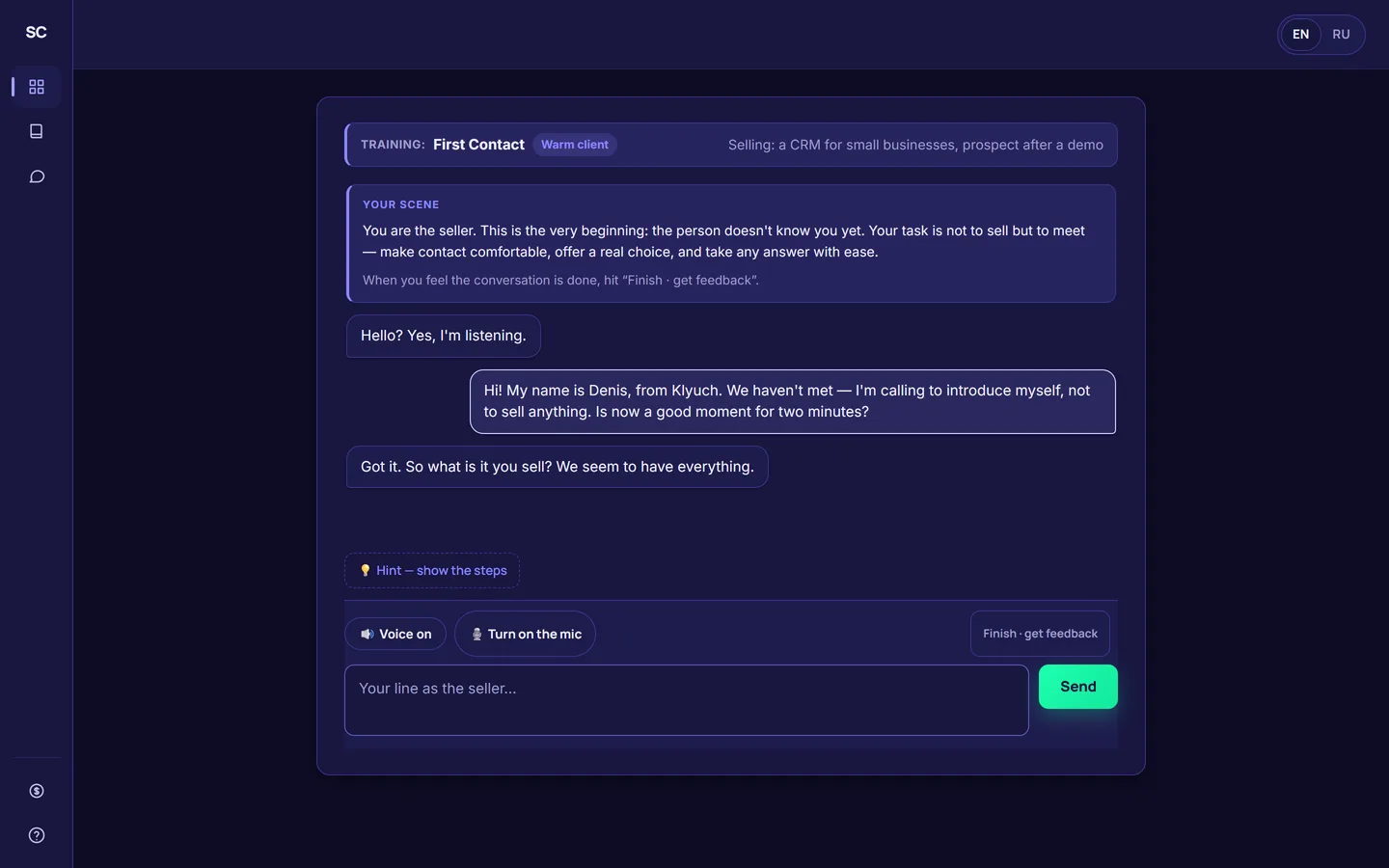
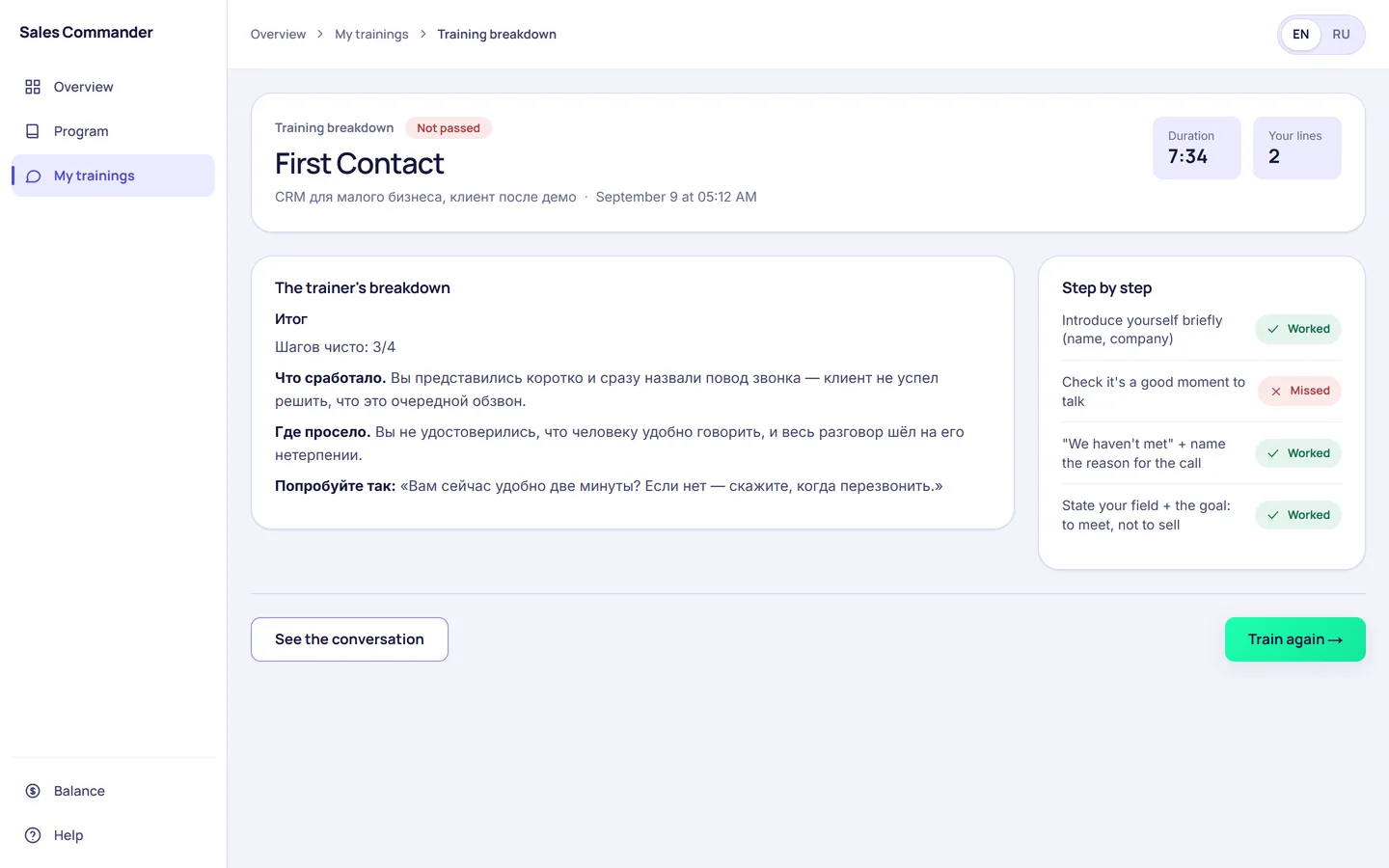
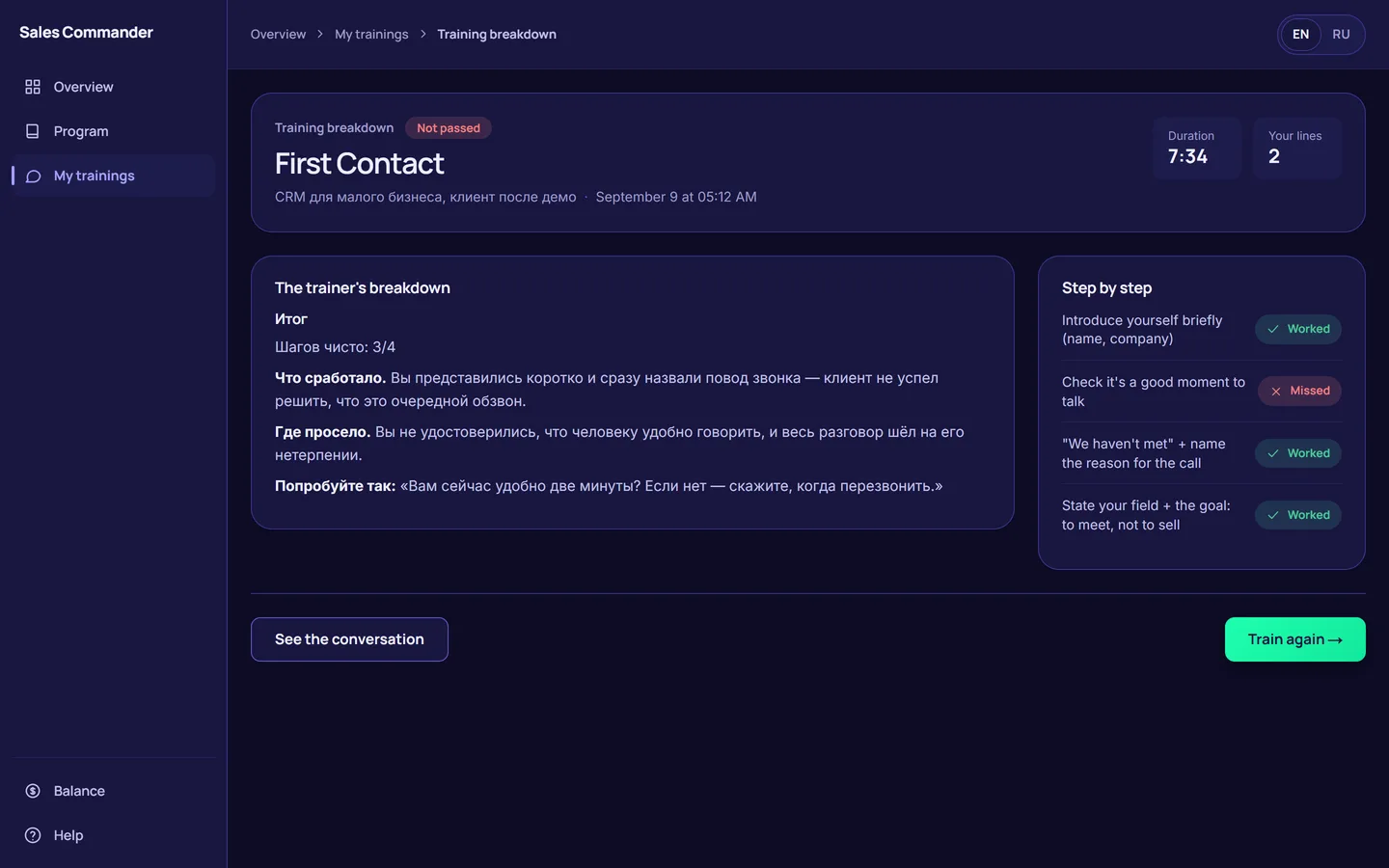
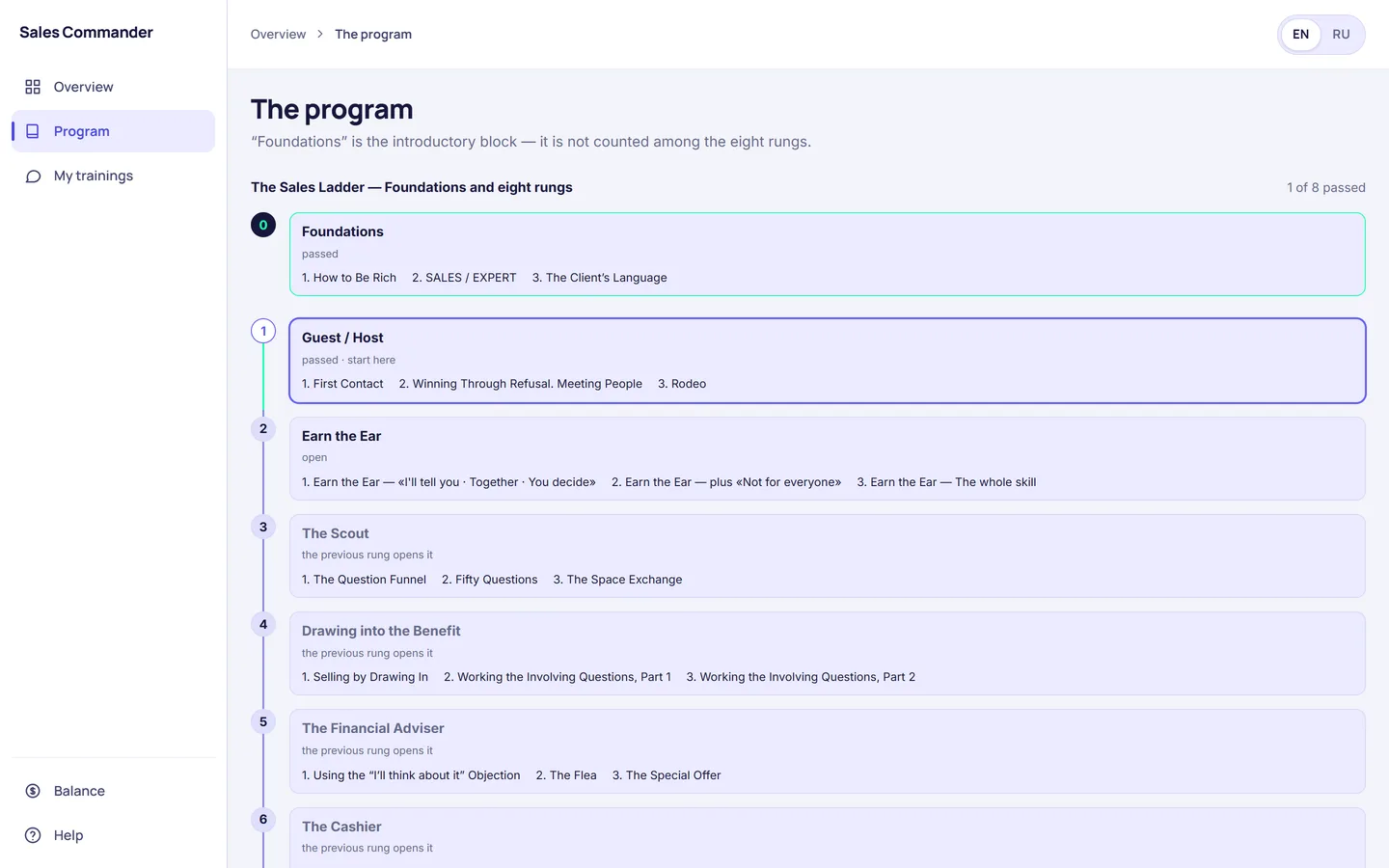
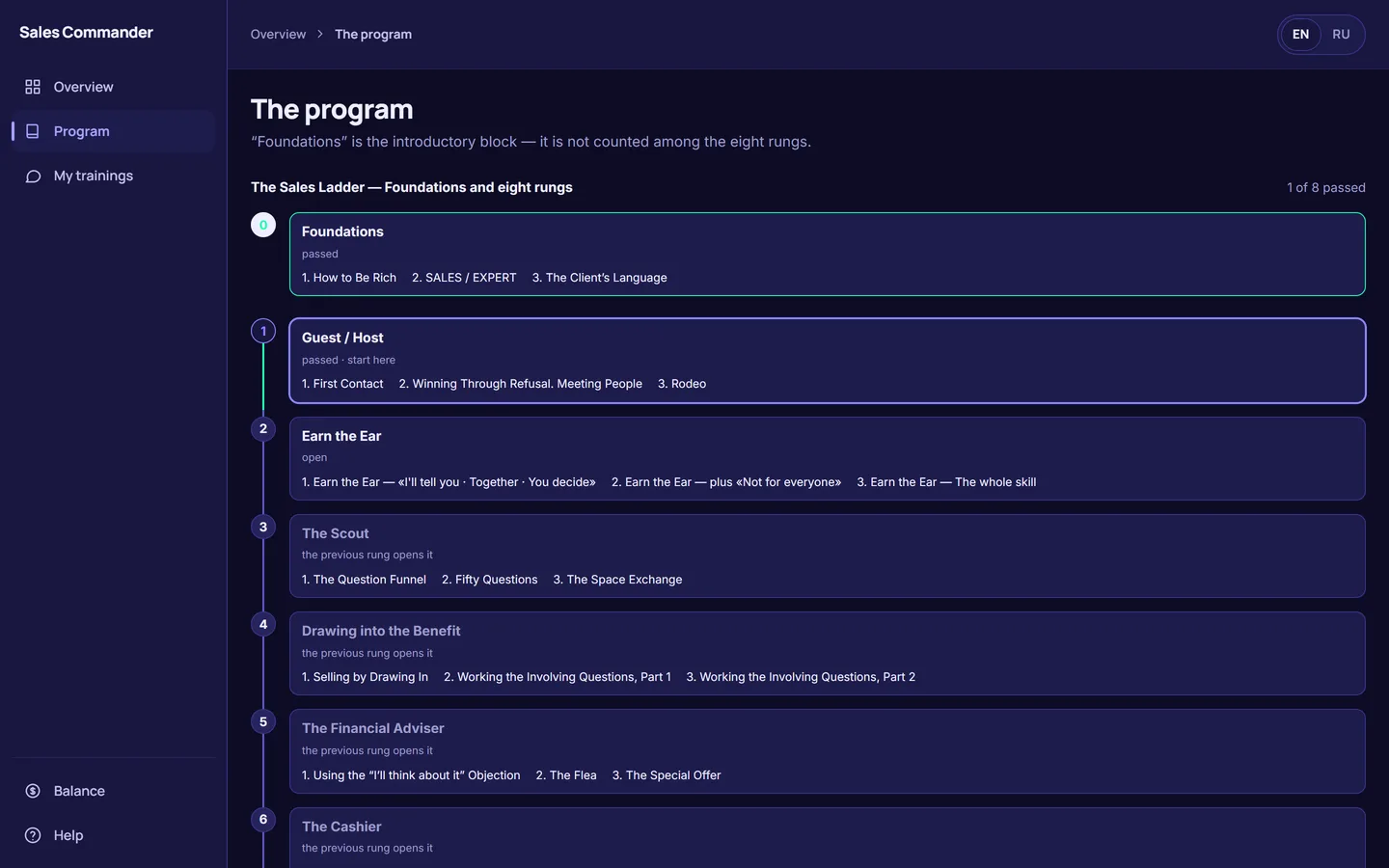
These are shots of the trainer itself, not mock-ups.
See the breakdown for yourself.
An example from “The Flea” (rung 5, “The Financial Adviser”): the client says “let me think about it.” Two ways to play it, and the breakdown you get after each. That breakdown is the product.
Pushed back and asked “why not?” — they got defensive and bailed. Desire never came back.
No pressure, reopened on what they liked, led them back to their own reason. Desire’s back on the table.
This is the breakdown you get after every session — step by step, on your own words.
Who needs this every day.
Sales reps, account managers, founders, sales leaders — everyone sells differently, but the conversation breaks in the same places. Pick yours and the buyer speaks your language.
Real estate
The viewing went well, then “we will think about it.” We bring them back to what they liked.
Start here →02Insurance
“I need to talk to my wife” right before the signature. We drill that exact moment.
Start here →03Car sales
They loved the test drive and postponed the decision. We learn to close on the same visit.
Start here →04B2B and services
A committee, a tender, “send it by email.” We walk the long cycle step by step.
Start here →05Home products
The client compares prices and walks next door. We sell the use, not the spec sheet.
Start here →Why we call this new.
We are not another AI sales coach, not another role-play platform, not another script trainer. Books and sales courses number in the thousands — what changed is something else.
- The buyer walks in prepared. They have search, reviews and AI — they read about your product before you ever called. Pressure, manipulation and a memorized pitch simply do not land any more.
- Lectures and scripts do not survive until the hard conversation. They are forgotten long before the client they were learned for shows up.
- What wins is not convincing harder, but helping the buyer decide with confidence. That is a skill, not knowledge, and it comes only from practice.
The system these times call for.
Selling should not destroy the salesperson.
A salesperson should not have to choose between results and self-respect.
They should not have to pressure customers to succeed.
They should not have to go numb to survive rejection.
And they should not finish every day smaller than they started it.
We believe professional selling can be different.
- gone:aggressionkept:confidence
- gone:pesteringkept:persistence
- gone:pressurekept:power
- gone:submissivenesskept:interest in the customer
- gone:fear of rejectionkept:the next call
Sales should develop people, not wear them down.
That is the profession we are building.
This is not a chatbot that praises you.
The difference shows in the first minute of the call.
- Agrees with you and adapts
- Shares its own opinion about selling
- Gives no verdict: the mistake goes unnoticed
- Forgets what you talked about yesterday
- Plays a buyer and talks like a real one
- Checks against one specific method, not general advice
- Delivers a verdict: would he buy or not, with quotes
- Remembers your progress and raises the bar
9 rungs of the Ladder, 27 positions.
Andrey Sizov’s method, put into a trainer: nine rungs, three positions on each. Not all of them are conversations — some are notebooks where you bring your own material, and some are drills with no buyer at all. Every exercise has its own passing score.
How to Be Rich · SALES / EXPERT · The Client’s Language
First Contact · Winning Through Refusal. Meeting People · Rodeo
One exercise in three gradients: steps 2–3–4, then plus step 1, then plus step 5.
The Question Funnel · Fifty Questions · The Space Exchange
Selling by Drawing In · Working the Involving Questions, Part 1 · Part 2
Using the “I’ll think about it” Objection · The Flea · The Special Offer. This is where a buyer hides behind “let me sit with it” — and where you learn to reopen the conversation.
Try for free →Agree the Payment · Help with the Payment · Let’s Be Polite
After the Payment, Part 1 · Part 2 · Value After the Deal
To Be Continued · No Need to Fear Us · Handling a Complaint
Choose how much practice you need.
Pay once for a pack, or take a monthly plan with 15% more tokens. The bigger the pack, the cheaper a single drill.
25 text drills or 41 minutes with the voice buyer
55 text drills or 91 minutes with the voice buyer
150 text drills or 250 minutes with the voice buyer
Tokens never expire and are only spent on drills you actually run. Text — 10 tokens · Voice — 6 tokens a minute.
Frequently asked questions
How do I use the trainer?
1. Sign in — the trainer opens on “Overview”. From the site’s home page, “Train” in the top menu leads to the trainer. The trainer’s sections sit in the left column: “Overview”, “Program”, “My trainings”. On a phone, the column opens with the three-line button in the top left corner.
2. At the top of “Overview” is the “Recommended next” card — click “Get ready”. You can pick another rung too: in the list below and under “Program”, an open rung has a “Start”, “Continue” or “Do it again” button. A locked rung says how to open it.
3. The “Set the scene” screen opens. Pick an exercise and read what it asks you to do. A conversation with the buyer has a “What are you selling?” field: the first time it holds an example — replace it with your own product or service, and the field will remember it. Choose there how you will talk as well: “By voice” or “In writing”.
4. Click the button under the form. For a conversation with the buyer it reads “Start the conversation”; the other exercises have “Open the workbook”, “Start the exercise” or “Open the table”.
5. On the scene screen, click “Start the conversation” once more and answer the buyer in your own words. Before the conversation starts, you can switch products right there with the “Change” button next to your product. When you are done, click “Finish · get feedback” for a step-by-step review. “Try again” repeats the exercise, and every review stays under “My trainings”.
Is this just ChatGPT with a different name?
No. A general-purpose chat can explain sales ideas. Sales Commander gives you a structured role-play: the AI plays the buyer, you respond in your own words, and the debrief evaluates the conversation against the selected skill step by step. It is practice with a defined method, not a promise of a particular sales result.
Will it work for MY product?
It is designed for products and services in both business and consumer sales. You describe what you sell and who the buyer is, then practice the selected sales moment in your own words. Because every real offer has constraints, use the free challenge to check the fit before buying tokens.
Do I have to sound like a script?
Just the opposite. There’s no script to memorize and no robotic lines to recite. You sell in your own voice. The training is about how you handle the moment — letting go of pressure, reopening the conversation, bringing them back to what they wanted. It makes you sound more like yourself, not less.
I close fine. Why would I need this?
Use the free challenge as a skills check: respond to an AI buyer who says "I'll think about it" and review the step-by-step debrief. It gives you a concrete practice result without claiming how you perform with real customers.
What happens after I pay?
The tokens land in your account within seconds and you start practicing. A pack is a one-time purchase: nothing renews and nothing is charged again. A monthly plan renews every month until you cancel it on the Balance page. Either way, whatever you don’t spend stays in your account until you do. They work only on salescommander.ai, inside your account. If the payment went through and the balance did not move, write to office@salescommander.ai and we will sort it out first thing.
You don’t need another script. You need the ability to keep performing when the script stops working.
After twenty, fifty, a hundred rejections, confidence falls. Calls get harder to make, conversations turn mechanical, difficult prospects get avoided. Some go passive, others start pushing — performance drops either way. We work on that cause, not on its symptoms.